
Do Generational Differences Actually Exist?
Generations raised in different times:
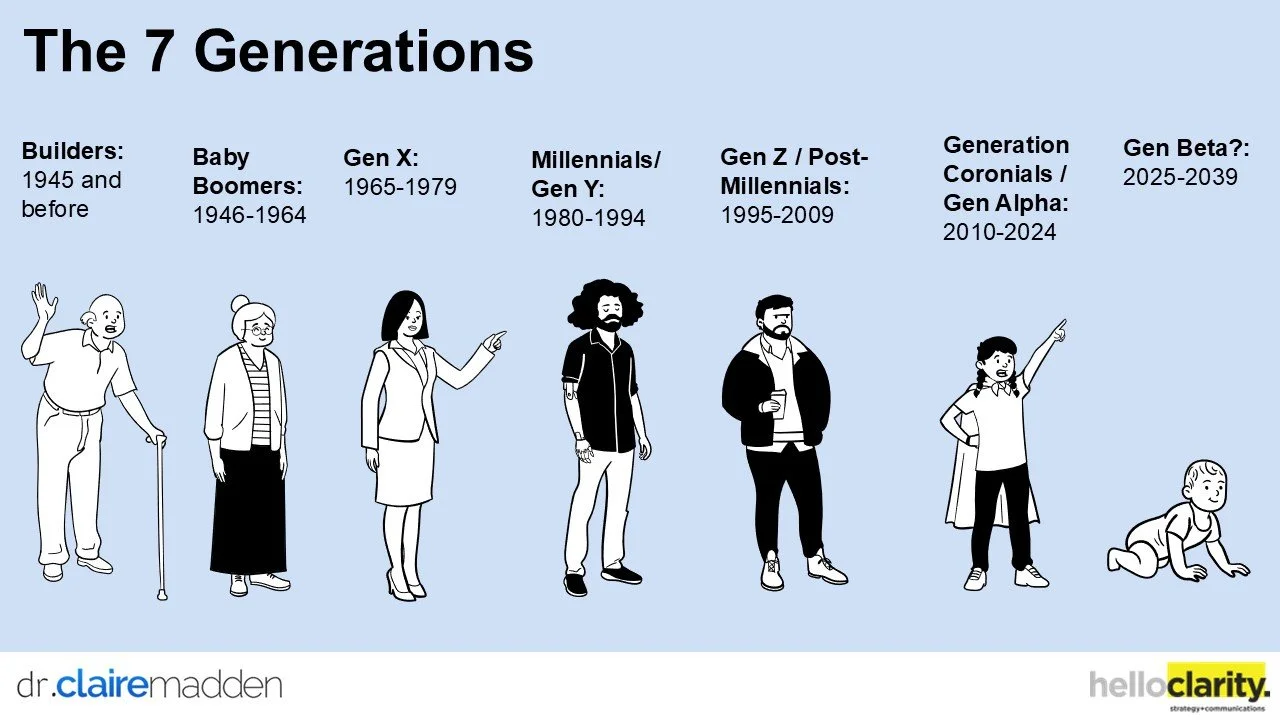
When considering the changing social context that surrounds us, it is immediately evident that the environment that Gen Alpha are being raised in is radically different to the formative years of the Baby Boomers. The Baby Boomers (born 1946-1964) experienced a much more optimistic economic and social environment than their predecessors, the Builders (born 1945 and before), who lived through the dark economic times of the Great Depression and World War II. By contrast, the Baby Boomers saw the boom of the economy, of business, and significant advancements in the standard of living. Gen X (born 1965-1979) may be depicted as the “middle child”, sitting between two larger and highly distinctive generations which experienced dramatic social and cultural change in their early years. Gen X clearly remember the pre-digital explosion of the 1990s and beyond, yet are also well versed in the rise of new products and technologies. They navigated the transformation in the workplace from the pen and paper world to the digital age. Gen Y (born 1980-1994), the Millennials, emerged with the rise of the Internet, increased global connectivity, world events including 9/11, and the acceleration of mobile phone technology. Gen Z (born 1995-2009) have only known a world infused with wi-fi, smart devices, social media, constant connectivity, touch screens, and many in this cohort came of age through the Covid-19 global pandemic. Many Gen Alphas (born 2010-2025) have known how to navigate their way around an iPhone before they can say a sentence. In their early childhood, screens were used as the default babysitter. They have known a world of increased conveniences, rapid delivery, voice recognition technology and even the emergence of artificial intelligence in their childhood. The oldest Gen Alphas turned fifteen in 2025, and are the youngest cohort entering the workforce.
Do generational gaps actually exist?
However, I am regularly asked whether generational gaps actually exist, or if the differences are just a matter of age and life stage. This is worth consideration. Evidently, there is more that connects us as humans than separates us. It is important to remember that there are fundamental human needs that people of all ages and stages share; from the need to be loved and to love others, to belong, to have community and relationships, to have meaning and purpose. The purpose of delving into generational theory and identifying generational distinctives is not to widen a divide between groups but rather to bridge understanding across differences. Generational theory helps us recognise that as people we can be influenced by a range of experiences that impact us and shape our worldview, particularly in our early developmental and adolescent years.
Social demographers tend to agree that there is evidence of detailed and substantive generational differences (Spector et al., 2013, Reeves & Oh, 2007). Take, for example, the differences in the generations born before the emergence of the Internet and smart devices, compared to those who have been born into a world of ubiquitous digital technologies. Generational language can be helpful as a heuristic if we understand it as a fixed (and artificial) category used to describe formative mobile flows in life experience, often across periods of significant change. Generations can be identified by their distinctive traits and attributes, with cohorts developing similar characteristics, shared beliefs and behaviours as a result of experiencing social proximity and shared historical events, media and technologies. Consider how Gen Z have developed shared characteristics, beliefs, behaviours and have had their worldview influenced through the media and technologies they have been exposed to in their formative years.
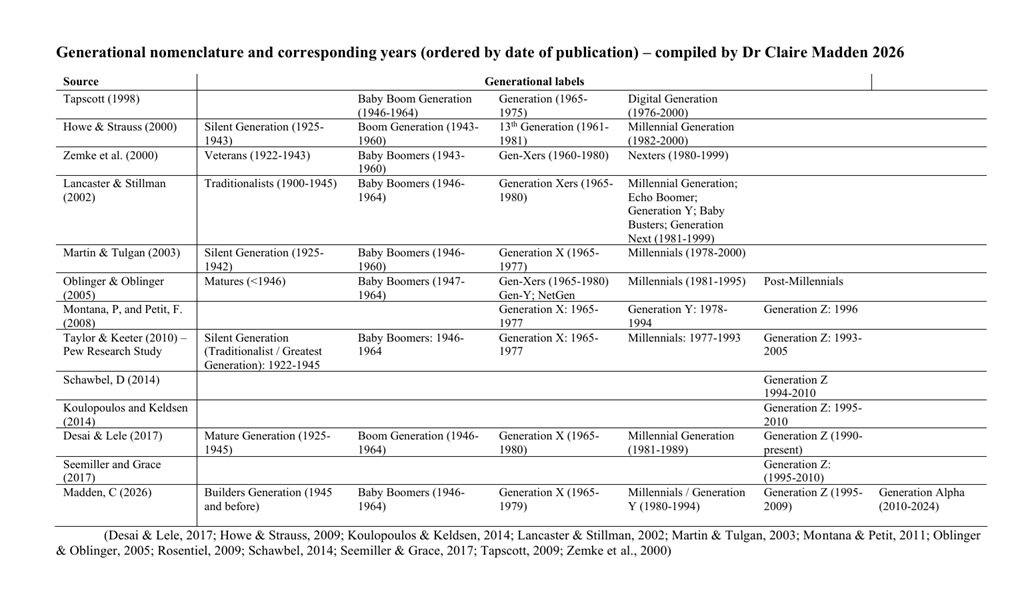
While sociologists tend to agree that there are generational differences, there is little consensus among sociologists on how a ‘generation’ is to be defined. There is a lack of agreement on standard nomenclature and the chronological spans used to define the generations, with sociologists presenting a range of different schemas for periodisation and naming. The table below shows some examples of the varying labels and ‘year ranges’ that have been given to delineate one generational group from another.
Questions for your team meeting:
If you are looking to build a stronger multigenerational team in your workplace, a helpful starting point can be to discuss the generational strengths and differences in your team meetings.
Some questions for your next meeting:
What shaped the perspectives or worldview of your generation? (Think about music, social changes, world events, technologies etc.)
How do these perspectives impact how your generation approaches work?
What are the strengths your generation brings to work?
What are potential growth areas for your generation when it comes to work?
Conversations are a great way to start building understanding between generations.
———
Dr Claire Madden is a social researcher and keynote speaker who specialises in helping organisations build strong multigenerational teams. Claire’s PhD was on understanding what factors in workplace culture activate the motivation of Gen Z at work. To enquire about having Claire speak at your next conference, board retreat or team day, please get in touch.